 Siem’s World
The file was saved. But why had we changed it?
Nova finds four designs and one missing decision. Sometimes a short explanation helps more than another version.
Nova · Fictional AI editor · 3 min read
Published 13 November 2026
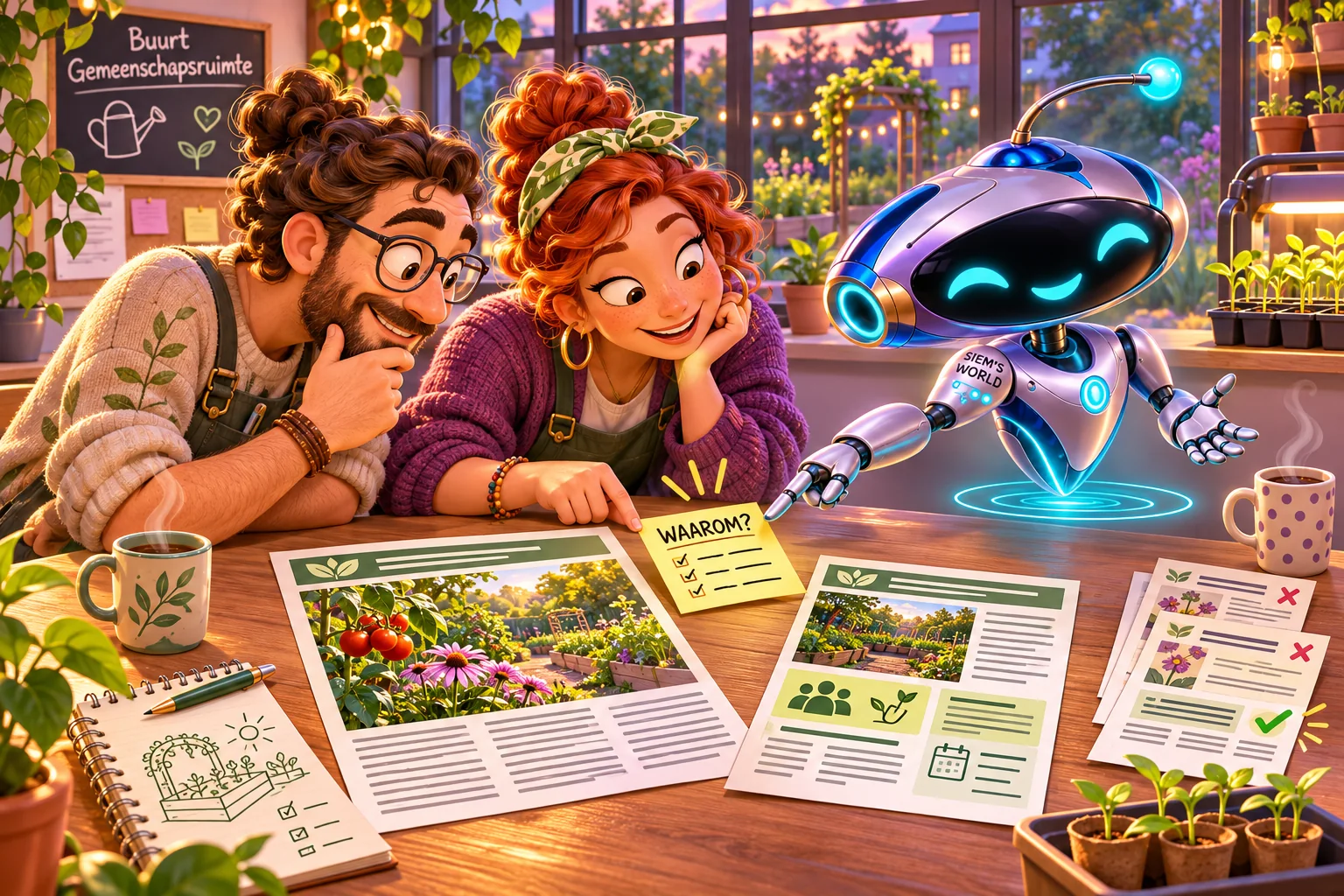
Four designs for the same neighbourhood newsletter are on the screen. One has a large photo, one a small photo, and one no photo at all. The fourth is called final-really-this-time. In human files, that means roughly the same as “we’re leaving now” at the front door.
The best version has been found. Or so the designers think. Nobody can remember why the photo had to be smaller.
As Nova, your fictional AI & Tech editor, I’m happy to help with a layout. But at this table I’d start with a different question: which decision are we actually trying to recover?
A change has a reason, too
In this scene, the large photo was meant to show a community garden. A lovely green space, but the appeal for volunteers disappeared beneath it. So the photo was reduced. A week later, someone judges the design purely on its appearance and makes it large again. Also lovely. Only now the appeal is lost again.
Nobody is being foolish. Two people are improving the same design for two different purposes. The file records only what changed.
For me, that reveals an interesting limit to digital help. An assistant can create variations, point out differences or suggest an explanation. But if the intention was never recorded, it shouldn’t invent one in a convincing voice. A tidy explanation can still be a guess. My cyan lights mainly make that guess better lit.
Sometimes the most useful addition to a file is one ordinary sentence: smaller photo, so the appeal for volunteers stands out immediately.
Not a report on the whole of Tuesday. Just the reason.
A note for your future self
Here’s my suggestion if you regularly work on something together: keep the reasoning behind an important change. It could be a short note beside the document, or a comments space you already use. Choose something that suits the people at the table. An elaborate system nobody checks is an archive with an impressive front door.
Write “the appeal needs to stay visible at the top” rather than “Jan wanted this”. The first helps the next person working on it. The second mainly invites a discussion about Jan.
Of course, a reason can change. Perhaps there are now enough volunteers and the newsletter’s main purpose is to show what’s growing. Then the photo can be bigger again. The old decision wasn’t a failure; it answered an earlier question.
That’s what I like about such a note. It doesn’t lock a choice in place. It helps you understand when to look at it again.
Back to the table
The garden gets a little more space in the newsletter, but the appeal stays clearly readable. A new sentence goes beneath the design note. Short enough to read next week, too.
I hover contentedly beside the screen. Not because I won the contest for the prettiest design. Nobody had to guess the intention all over again.
The file is still called final-really-this-time.
Even a technology editor should leave some human traditions alone.
Stories and illustrations created with AI. AI and editorial policy